
Embracing the complex terrain of personal loss can begin the profound alchemy of grief, transforming what feels meaningless into a search for purpose. Joining Haseena Shaheed-Jackson is author Alyssa Noelle Coelho, who shares the deeply personal story behind her magical realism series, The Lionheart Chronicles, starting with The Alchemy of The Beast. Sparked by the unexpected loss of her father, Alyssa’s journey is one of unraveling old beliefs, confronting uncertainty, and redefining one’s identity at “Ground Zero.” She discusses how she channeled her experience into the fictional character, Scarlett, to create a catalyst for others’ healing, emphasizing the powerful belief that “the answers are in here to create,” and that healing and grieving can coexist.
—
Watch the episode here
Listen to the podcast here
The Alchemy Of Grief: Where Healing And Grieving Coexist With Alyssa Noelle Coelho
From Loss To Literature: The Catalyst For The Lionheart Chronicles
Alyssa, thank you so much for being here on Change Your View, and I’m excited about the discussion that we’re going to have because you wrote a book and it’s actually part of a series, The Alchemy of The Beast (Lionheart Chronicles 1). The book that’s out now, and you’re working on the second one, but you have such a fascinating story that I think is wonderful to tell the story behind the story, because we read the books, but we really never know what the author was thinking? What was the catalyst that made them write this book? That’s what we’re going to talk about. Let’s just dive right in. What moment or experience made you realize that you needed to write this book?
I’m excited to be here and talk about this because I’m in the thick of writing the second book, and it’s always reflective when you remember back to the first experience, writing it raw. The catalyst for this first book was the moment I lost my dad. I lost my dad in January of 2017, and it was unexpected. My first experience with death at 21 years old.
I had left the belief system that I had grown up in. I was like ground zero, no coping mechanisms, no idea how to deal with this giant thing that just rocked my world. I was his caretaker, I was his best friend. I was on his hip for my entire life. It was an extremely traumatic experience for me. I was not dealing well. I was not coping with it well.
I had a book land on my doorstep by Dan Millman, Way of The Peaceful Warrior. I was thinking, “Why the heck did my sister send this to me?” It was written by an Olympic gymnast. What does this guy have anything to do with my life? It was so transformative. I consumed that thing, I devoured it in like three days. I had the rest of his books on my doorstep, and I bought a ticket to his retreat in Costa Rica in the next few months that were following.
I went to this retreat. It was my first time out of country. My whole family was looking at me like, “You’re not in the right state to be traveling alone to a country where you don’t speak the language and where are you going?” I was going into the middle of the jungle for an experience I didn’t really anticipate. I didn’t know what I was signing up for. I just knew that it was my right next step.
I showed up and I ended up having this week of incredible synchronistic. It was like a series of synchronistic experiences that just catalyzed the next phase of my healing. When I came home, I said to my sister, who was not the right person to say this to because she had built a career for twenty years helping people write books and heal their own stories and messages. I was like, “I could write a whole book on that entire week.” She ended up helping me map out a whole series from that experience.
That experience is the first book. The whole series follows Scarlett Leonelli, this second-generation Russian Italian immigrant, through the tragedies that life throws her way. She travels to different countries and has these types of experiences that help catalyze her healing and teach her the next Law of the Universe that she needs to heal through and alchemizes tragedies.
It’s interesting that you say that, and you referenced it a little bit when I asked about what was the catalyst, you said that all these emotions and feelings surface. What emotions and feelings surface as you went on this experience that you had to deal with? Describe some of what you felt and what was going through your mind.
Primarily, the thing that gripped me was the idea of meaning around after he passed in the weeks and months that followed. Right before he passed, I had published a book, my first book I had ever. It was a poetry compilation. I had started a business. I had just started college. I was opening all these doors to the rest of my life that I was getting really excited about building. All of a sudden, the pillar of my world and my foundation died. I was trying to reason with it.
I was sitting behind my desk every day wondering what the heck any of this meant? Why am I sitting here doing all these meaningless things? It was like this wrestle with purpose that showed up and everything just seemed so meaningless to me. It propelled me into this meaning-seeking journey of what the heck does our everyday mean? How do we create that meaning-driven fulfillment in our lives?
This experience that you had in Costa Rica helped you find the answers to those questions, it seems what I’m hearing. Yes or no? What meaning?
I don’t know that those are answers that we can just find like treasure hunting. I think those are ever-evolving questions in our life as we go through the phases of life and the different seasons of life. We find meaning in different places. We learned how to create meaning on our own. The experiences that happened in Costa Rica were more like they helped mend the details because grief is never simple. It’s never, “I lost this person and I am sad.” There are so many different dynamics.
As we go through the phases and seasons of life, we find meaning in different places and learn how to create meaning on our own. Share on XGrief is a very complex thing, and especially when it’s in a relationship with people we had complex relationships with. You’re grieving so many different things. You’re grieving that person’s life. You’re grieving who they were to you. You’re grieving the future you thought you had with them. You’re grieving all the things around you that have to change in your everyday lives because that person’s gone.
There are all these different elements that we don’t anticipate. I wasn’t prepared for it. I’d never dealt with them before, and that’s not even talked about, like the specific relationship that you had with that person for however many years. All these things happened in Costa Rica that gave me the opportunity to dive deeper into these things. Especially in a relationship with myself, because I didn’t know who I was anymore without this person who was my defender and my warrior, my entire life.
Redefining Identity At Ground Zero: The Purpose Of Fictionalizing Grief
It’s interesting that you say that because one of the things that I really reflect on a lot is that who are you, your true identity that you must define and not who someone else told you to be, or who the world said you are to be. It seems like you were grappling with that because like you just said, you had this person that was always there, so you had your. As you said earlier, you were joined at the hip, so you didn’t really see yourself different from them yet.
It sounds like to me, when your father passed, this was your like cold water being thrown in your face to wake you up to say, “You’re Alyssa. Now you need to find out who Alyssa is and what Alyssa is going to do going forward.” That’s what I’m hearing from you. You come back and you have this experience that says, “I’m going to write a book and help others.” What was the meaning behind this book? It sounds like to me when you came back you said, “I’m going to write a book,” what did you want a reader to get out of the book?
I think, like many other people who decide to write a book, we think we’re writing it for other people and then it really turns out to be a whole healing journey in itself as we’re giving ourselves the medicine that we’re hoping to give other people. I was very particular when I started this book like that, I don’t want this to be a self-help book. This isn’t a memoir. I don’t have any answers to give. I’ve always been like, “I am not a teacher. I am not someone who’s going to stand on stage and give people steps of how to heal or how to get better.” I’ve been in the industry of that for a very long time. It’s never felt good. I was trying to find a unique way to do it.
We think we're writing a book for other people, and then it really turns out to be a whole healing journey in itself. We're sort of giving ourselves the medicine that we're hoping to give other people. Share on XAs I was writing, I had such a magical experience with the writing and with the characters that I started fictionalizing it. I wrote the first draft very raw, and then went back through several times and fictionalized it and finally changed up the characters’ names and just added a whole lot of magic in. It really transported people into an experience where they felt like they were Scarlett, and they were identifying so much with all of the complexities of her grief that they see themselves. They see their stories. My intention was to create a catalyst for their own healing journey so they can walk through all of the different dynamics of grief themselves and start to reflect on it and heal it.
I love the way that you are giving this as a resource because it’s really speaking to your story. Everybody processes grief differently. That’s what needs to be clear because I really cringe when I hear someone who says, “They should have gotten over that by now. I’ve moved on, so they should have too.” Everybody processes grief differently. As we go through this, The Alchemy of The Beast, it’s really about the beast’s grief?
Essentially death. I want to just share all of it, but it’s hard not to give too much of it away.
I just want to say, but the beast is grief and we can leave it at that, and I can totally relate that the beast is humongous and you have to really be willing to face it in your own strength and light and not someone else’s light, but you’re giving them your walk that occurred, which is good. They might see some similarities.
Yeah, it’s an honest walk. As I said, at the time, I had just started college and was falling in love with all of my multicultural studies and learning that there were other religions out in the world other than what I had been taught. I was unraveling. I was in this place of unraveling these giant pillars of my existence and trying to figure out in that department too, who am I without all of these things that other people have taught me and tried to make of me and then I lost another pillar.
It was this constant unlearning of those things so that you had a clean slate to move forward. I had watched, I had someone alongside me who was going through the same thing, my sister and we were transitioning out of this home religion together and then we lost my dad. All of these statements come in like, “Jesus took him early and he’s with the angels now.” All these things, they did not resonate with me. They frustrated me so much and I was just like, “I am not here.”
This constant unlearning helps you have a clean slate to move forward. Share on XI had this mirror of watching my sister go back to those things because she found comfort in them, and some people do. I was at this the point of no return I can’t go backwards, so I have to go forward. That whole terrain of uncertainty, I just have no idea how to navigate. My intention with Scarlett was to stand as this sometimes reckless, but often very tenacious example of, “No, we’re going to brave the uncertainty because what we’ve been doing hasn’t been working and so we’re going to find different ways to figure this out going forward.”
That’s ever evolving in life. As you said, that statement around, “They’re not over that yet?” It’s been many years for me now. I had this experience. I was moving and I have this whole section of my closet that’s my dad’s sweaters. I was like, “What’s the most efficient way. We’re downsizing and I’m wrapping them, I’m putting them into a suitcase.” I’m rolling them all up, putting and sniffing them just to see. No, they just smell like dust. We always do that. They just smell like dust. I’m wrapping them up and they’re not fitting. I’m like, “I am going to make a pile for my brother-in-law because I know that it will fill his heart so much to get some of these.”
I’m putting five sweaters in. Over the period of an hour, going back and taking them out of the pile for him and folding them up and putting them in the suitcase, and I just broke down sobbing because I had this moment of like, how many years is it going to take? How many things of his, how many pieces of him do I feel like I need to hold onto so that I know that he’s still with me?
I totally can’t relate to that. My brother committed suicide many years ago. I still have had pieces of him around my house too. I still have his ID because I just want to be able to see his handwriting. I have pictures of him in my house. As you said, you are always clinging to things that were a part of that love one that you just won’t let go.
The Hardest Change: Embracing Uncertainty Over Answers
It is right here by my desk. I pull it out and I have his wallet with his things in it. I can’t use them and no one else can either, but I’m just not willing to throw them away. You raised an interesting point that I would like to go back and touch upon. You had to change, it seems to me, a perspective of belief as you were going through your process. What was the hardest to change?
I have a moment to share with you to answer that. My sister Amanda braved this journey before me around this spiritual crisis and unraveling of the old beliefs to build ones that are more true for ourselves. She was a confidant during that time. I had shown up at her house just crying one night. I was around nineteen years old. I showed up there and I was just like, “This and this and everything I knew and the answers I thought I had.” She just like stopped me and said, “What if there is no answer?”
I had just read a quote that said something along the lines of our peace doesn’t come from having the answers. That just feeds our control. Those two are correlated. That was the beginning of my journey with uncertainty. That was the beginning of my unraveling down to ground zero. What if there’s not this holy, sacred answer around the globe that everyone knows and I can’t figure out for myself?
That’s why I’ve carried that theme into my work as a writer. My goal here is not to give people answers. It’s to give them safety. It’s to give them compassion, empathy along the journey because it’s ever evolving, especially the conversation around grief. This is not something you’re going to wake up one day whole and healed and you’re never going to be sad about it again. It is not reality.
I have 364 days out of the year that I can talk about my dad and the presence that he was on this earth and his power and do it with such happiness for the life he lived and be at peace with the time that he exited the earth. It’ll still hit me every once in a while. I’ll still have that one day a year where I am consumed by grief around it. They can coexist, healing and grieving.
Healing and grieving can coexist. Share on XIn your bio, you have a statement here, which I think speaks to what we just talked about. You said during your journey, you have unearthed some deeper truths behind the things we call the human experience. What were those deeper truths?
You’ve got to read the books to find out. You’ve got to go along with Scarlett to find them out. I’ll tell you, Dan Millman, one of his books that really inspired me was The Laws of Spirit. Did you read it?
I did read it. I wanted to tell you. I finished it. That was a very wonderful book.
It’s so powerful. A short, sweet, powerful fable walks into the forest with a sage and walks through the Law of Balance, the Law of Choices, the Law of Harmony. It’s an interesting take on the laws that govern our human existence that maybe we’re not aware of. Once we start tapping into those, we start unearthing these deeper truths inside of ourselves. We start asking ourselves the questions around our meaning here. How much of that is within our choice, our power, and how much of it is maybe written in in the stars?
The Law Of Choice: Taking Back Power In The Grieving Process
We’re segueing here a little bit because one of the laws that really stuck out the most to me, which I think is apropos here to our discussion, was the Law of Choice because I love what he said in the book when the sage says we’re talking about his marriage and she says, “Just go home and get a divorce.” He says, “I can’t because I have to,” but then she says, “Then it’s not a choice anymore.” Have to take away choice. You have to be willing to accept whatever consequences occur, but know that you have a choice to make, that you can make. It’s not based on what someone else says, but really what you are can accept and move on.
That really resonated most with me because, again, it goes back to what you’re saying here about grieving. It’s your choice how long you will be in this process, but you also have to make the choice of when you can move forward. That’s what I heard when we first started here. You took that journey out of the country because you had made a choice at this time for me to do something in order to move forward. That’s the whole point that we have to understand is that that individual, whoever is in this situation, the choice is always theirs.
It’s a hard pill to swallow. It’s really easy to skate through certain things in life when you attribute that lack of choice to some other force in the universe. When you take that power back to yourself, I’m in the trenches wrestling with this law right now because the first book was attuned to the Law of Presence. There’s a lot of here and now in that grounding lesson in theme in the first book and the second book’s all about the Law of Choice.
The Law of Presence is powerful, too. I was reading somewhere, and don’t quote me on the statistics. I think we spend 60% of our time in the past and only maybe 10% or 15% in the now and the other is in the future. We are spending only a small portion of our time in the present, which is what we can control right now because we can’t control the past, we can’t go back and do over, and we can’t predict what’s going to happen to us in the future. All we can do is take the action that we need to do now. I think that Joyce Meyer says it best. She says, “Most important time in your life is right now.” That is so true.
Let’s move on to someone who’s in this situation right now who’s grieving, who’s going through a process, and they don’t yet have your book. We know based on this conversation, they’re going to get your book because they want to resonate with Scarlett and see how she’s going to continue to heal and go through her journey to see maybe how it resonates with them and possibly what they need to do because it might spark some thought on what they need to do for themselves. You’re saying it is not you telling them what to do, it’s just you sharing your story that might spark something in them. What do you wish that that person who’s reading right now could see that they might not see yet?
That’s a great question to which I would respond with ready is a choice. It’s very rare that we feel like we’re ready for the next steps or for whatever is next or for the uncertainty that we know is required to get to place in our journey that we want to be. We really have to ground ourselves in that now and make that choice for ourselves. I am choosing to be ready. It’s a mental thing before it’s actually physical action.
You have to say when it’s time. However, what I caution you on is that you don’t get stuck in waiting for the perfect time because it will never be a perfect time. You have to be willing to take that risk to just say, “Today is the day that I take one small step, if it’s just me walking around the block and coming back into my house, and then tomorrow, I walk two more blocks.” It’s just those incremental steps that we have to be willing to take and not think about, “I’m going to go to the store and I’m going to meet five people.” That could be really overwhelming.
I’m going to get my whole to-do list done one day. It’s pretty overwhelming.
The Grief Gem: How A Scientist Brother Redefined Life After Loss
I am a big proponent of just that small thing. Let me ask you this, and I never was one. Let’s say I want to go back, but if you could go back to yourself and have helped yourself, what is something that you might have said differently to help you along a little bit sooner? Do you think you had to be sooner? I want you to just tell me your thoughts on this because everything is a process and I totally believe that.
There was this real gem that came to me along the journey through my brother and I put this in the book and I formatted it specifically this way so that the question was posed at the beginning of the book and it was answered at the end of the book.
You have to read the whole book to get the answer.
I’ll give you a little spoiler because this was a super deep one that reached me in my grief. As I said, a lot of people said a lot of different things to me while I was grieving, and I just wanted to punch all of them in the face because none of it resonated with me. I was so full of confusion and anger. I remember sitting, because my brother took the route of science, he became a scientist. He had unraveled everything that we all grew up with in the home first and taking that route.
He and I were parallel along this journey of what we’ve learned to cope with this and reason with death and the afterlife and everything before it doesn’t resonate anymore, so what else is there? I remember laying in the crevice of my dad’s shape that was still in the bed a few days after he passed. My brother was sitting at the edge of the bed and I said, “Religion aside, concepts of thought aside, what do you think happens to the human essence to the soul after death?”
I would like to hear what he said.
I called that at the beginning of the book. At the end, I flash back to his response and he said, “Kid, what I do know is that dad’s actual DNA lives on in us. His mannerisms, his generosity, everything that was modeled for us, everything that he spent all those years investing in us, he’s actually living inside of us in our blood. He lives on. Those things live on.”
That just felt like water to the desert that was my soul at that time. It was like the one thing that sat in that I could latch onto and use to create meaning in my everyday life going forward. That was tangible for me. What I do and who I am in the world going forward matter and are influenced by all of the things that he left with us.
It sounds to me like that’s what resonates the most that could help someone is thinking about your loved one might have passed away, but their DNA lives on within you. That’s something you can be able to help someone in that process. It’s funny that you would say that because sometimes, when I am talking, I feel like it’s my brother talking. I’ll have to go, “This is Haseena,” and I know it is, but it’s just the fact that I can feel his presence at different times when I’m having conversations.
I take it as more of a comfort, but it’s an out-of-body experience because that just lets me know that he’s with me and he’s never left me, just like you just said there. We can’t take that as, “No, you can’t even have those thoughts,” because who’s to say what’s the right thought and what’s not? A wrong thought is not saying I’m going to go and kill someone.
Let me just clarify that because I’m speaking about the spiritual aspect of things here of what’s right and wrong. We have to be comfortable with accepting what we believe when there’s evidence that supports it, versus allowing someone else to say, “Why would you think that?” I have to counter with that with, “Why wouldn’t I think that? What evidence do you have that is not true?”
I have quite a funny example of that because I have a dear friend of mine who lost a baby. Her grieving process had its own complexities, but she had a very auditory experience after this happened. She swore she heard her baby’s voice all the time and she was talking to her all the time. She had asked me like, “Do you ever hear your dad’s voice?”
I was like, “I hear my dad’s voice every day, yelling at me every day to go unplug the iron, to make sure my keys aren’t still in the door, to make sure my gas tank is full.” Those things. What he always said, “My voice will be the last voice you ever hear.” It sure is. Those people live on in our memories. They live on in all the ways they weaved us into who we are. It’s a beautiful thing once we realize it.
Once we start seeing them show up in who we’re being here, I think it’s a testament to who they were, too. We all have our strengths and we all have our shadows, but I want to be remembered for the things that made me unique in the ways that I impacted the lives around me. When we can reflect on someone’s existence here and take those things from it and keep them alive in the way that we choose to be here on this earth, that’s magic to me.
Magical Realism & Healing: Alyssa’s Intimate Writing Process
Let’s segue a little bit about the writing process, because I’m sure there are a lot of writers that are reading. What is your process for writing? Everybody has a different process, so there is no right or wrong answer. What is your process for writing your books?
These books in particular, this whole series is magical realism. Every book is based heavily on my own experience. It’s got my bones in there, it’s got my actual life experiences there. I always write it raw the first time I write. The whole manuscript is raw as it can get the first time. There is very potent healing quality to doing that because you’re getting very honest with yourself about how the actual stories played out because things get twisted up here over time.
When we go back and we write and we reflect, I make sure to have a safe space doing this. I write my books with my sister through Save by Story, and we have a retreat-based model and a community-based model. We do little cohorts that we do four retreats in person a year, and then we have a virtual retreat every month so that we have a nice, safe space to actually cradle the process that we go through because writing is such an intimate process.
As I said, you get real honest with yourself. Sometimes, when people are writing their own stories, they touch old pain points and they have weird things start happening in their lives, and the people around them start channeling their characters and all these interesting things start happening. You need a safe group of people to process those things with. Those are two really big elements, the retreat-based part so that we can get out of our normal lives, even if it’s for 72 hours just meeting online and just making sure you have a strong backbone of community.
As far as the creative process goes, I write it raw the first time I go back and I fictionalize everything. I go back again it’s a million draft. You have points in the process where you finally, like a little detachment happens with the characters when you give them their special names. You give them their own names outside of what they were in your life. That’s a little bit about my process.
It’s very different for everyone. It’s different depending on the work too. I started a fantasy series, and that is not based on my own experience consciously at all. If my stuff’s sleeping in there, it’s not at the forefront of my intention in writing. That one’s coming to me in a completely different manner. That one, I saw the map first, and then I started seeing the characters and then the characters started talking to me in my sleep.
I’d wake up and I’d write their conversations and I’m like, “I don’t even know what the whole story arc of this world is yet,” but the world is starting to come together and build itself. Every project has its own essence. It has its own soul. I think part of the creative process is learning how to communicate with it, learning what wants to come through, learning what type of space you need to give yourself for it to start to come alive for you.
Part of the creative process involves learning how to communicate with it—understanding what wants to emerge and determining the necessary space you need to allow it to fully develop. Share on XI like the way you put that, because sometimes we think we have to go chapter by chapter and it has to be in sequential and it has to be all organized. You might have a story that comes to you, just like what you said, and you just will write it out and you’ll find a way to get that inside the book. I think as writers, we need to be flexible to allow whatever flows to come on out. You can go back, like you said before, and connect it all together. I’m a firm believer in that because then you pigeonhole yourself.
The Philosophy Shift: Answers Are Created, Not Found
I have a question for you, two more questions, and you have answered it, but I want you to solidify it. How would you complete this sentence? “I used to believe blank, but now I know blank.” You used to believe this, but I always feel there’s a knowing, but now you know what. What do you know? I’m sure there was some changes, right?
I would say that I used to believe that the answers were out there to find, and now I believe that the answers are in here to create.
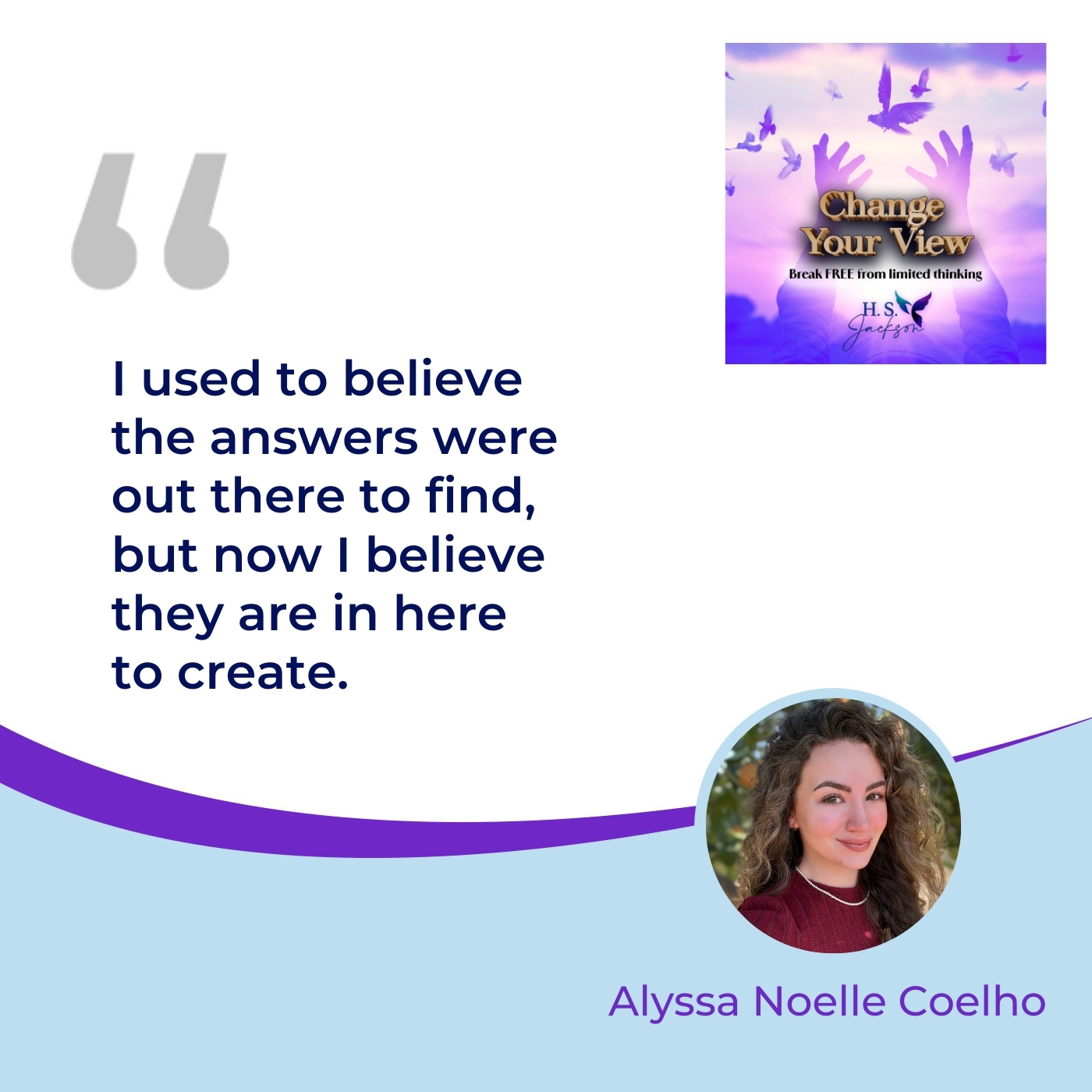
Expand upon that a little bit more. I love what you’re saying. Expand upon that.
There’s this beautiful part, the really big element. I did my degree in Sociocultural Anthropology. I love traveling. I love immersing myself in other cultures and learning about their traditions and belief systems. This was a huge part of my meaning seeking journey. Taking myself out of my ordinary and putting myself in very uncertain situations to learn about other people and other ways of life and other mindsets.
That propelled me on this traveling around the globe to find purpose, to find answers that were out there and waiting. What I’m hoping to infuse into my writing is the empowerment that our brains and our bodies and our souls are so powerful. We have so much choice. We have so much will. We have so much say over the things that we create in our life for ourselves.
It’s a tragedy to me that people get very lost in trying to find answers outside themselves when we realize that when we take all of that energy back to ourselves, we have the ability to create those things for ourselves. We have the ability to create magic and to create meaning in our lives and to create who we want to be to make a difference with the people that we interact with in our time here on earth.
What words of advice and wisdom which you share with an author who is grappling with writing their stories? It’s like you just said before, it’s not so much writing for others who are really writing for yourself, because this could be a process for you. What would you tell someone who’s sitting here trying to move forward and take that first step to writing?
I think the biggest priority I would say is to create safety for yourself, however that may look. Everyone’s lives are different and usually very busy and consumed with obligations for work and for other people. It’s a very difficult thing to do. I would say to create enough safe space so that you can get intimate and honest with your own story so that you can process the things that need to be processed and learn how to move through them and alchemize them into something that you can be proud of and something that you can share with other people.
Conclusion: Final Wisdom And Finding The Alchemy Of The Beast
We’ve had a good conversation here. We went from why you wrote your book and what was the perspective and changes that you underwent. Is there something that I did not cover that you want to leave?
No, I think we hopped around a few different worlds in 40 minutes.
Tell everyone the name of your book again and where they can find it. We want them to get this valuable book because I think it’s going to be very useful for someone who’s going through.
I hope so. I hope it’ll do just that and catalyze a nice, safe space for people to brave the parts of their own journey that they’re ready to. It’s called The Alchemy of The Beast. It’s on Amazon and you can watch a few book trailers and read more about it at LionheartCreations.org.
Thank you so much, Alyssa, for having this conversation with me. It was very enlightening and you’ve opened up my eyes to a couple of different perspectives as well. That’s what it’s all about. How can we change our view? We think it’s stuck seeing things one way, but we really need to open our minds to seeing from a different perspective.
When we do that, we open up doors that we thought to be closed that were really was where we needed to go and go through to keep moving forward to where we need to be. I’m a firm believer that to be does not ever end. It’s constantly evolving, like you said before about when I asked you that question. You said it’s the destination is never reached. I thank you for your time and I look forward to the next time that we chat.
Thank you so much, Haseena. It was such a great conversation.
Important Links
- Alyssa Noelle Coelho
- The Alchemy of The Beast (Lionheart Chronicles 1)
- Way of The Peaceful Warrior
- The Laws of Spirit
About Alyssa Noelle Coelho
 Through Alyssa’s sociocultural anthropology training at UCSD and many seasons of disconnection with her soul and source, she unearthed some deeper truths behind this thing we call human experience and learned to alchemize her own tragedies into a greater sense of meaning and adventure.
A traveler at heart, novelist by craft, and poet at soul, she immerses herself in cultures worldwide, studying their traditions and transformations through the lens of meaning and purpose for years.
A lover of novelty, she uses the power of words and stories to romance humans into falling in love with their precious existence, creating extraordinary from the ordinary. She reminds others of their wild potential, of their hungry spirits, and of the entire world awaiting their unique gifts.